


SikaTile®-550 Titan LHT Set
SikaTile®-550 Titan LHT Set is a superior grade, single-component, non-sag, non-slip lightweight polymer-modified mortar for interior and exterior setting of large and heavy tile and natural stone and may be applied from at 3/32" to 3/4" (2.4 mm to 19 mm) thickness to provide better support under large and heavy tiles and stone and can be used for both interior and exterior installations of tile in most residential and commercial floor and wall applications. SikaTile®-550 Titan LHT Set, features innovative DUSTLESS Technology producing approximately 80% less dust than ordinary thin sets and is designed to promote cleaner working conditions and reduce mess. It uses less water and is creamier and easy to spread.
- Non-sag and slip resistance for large and heavy tiles
- Non-slumping formula eliminates tile lippage
- May be applied up to 3/4" (19 mm) thick on horizontal applications
- Flowable properties reduce the need for back-buttering
- For interior and exterior floors and walls
- DUSTLESS formula – provides approximately 80% less dust than ordinary mortars
- Promotes cleaner working conditions by minimizing dust
- Creamier and easier to spread
- Uses less water for consistent hydration and quicker drying
- Longer working time
- Mold and mildew resistant
Usage
SikaTile®-550 Titan LHT Set supports large and heavy tile for flat, even installations and is suitable for bonding the following types of tile and stone:- Brick and thin brick
- Cement-based precast terrazzo
- Impervious porcelain and glass tile
- Natural stone tile
- Vitreous, semi-vitreous or non-vitreous tile: Ceramic, mosaic, quarry, cement body tile
- Brick Masonry
- Cement Backer Board1
- Cement Mortar Beds
- Cement Plaster
- Cement Terrazzo
- Ceramic Tile and Stone
- Concrete
- Concrete Masonry
- Exterior Grade Plywood2
- Gypsum Wallboard2
- SikaLevel
- SikaTile® Membranes
- Approved SikaLastic Under Tile Waterproofing 1 Consult cement backer board manufacturer for installation recommendations and to verify acceptability for exterior use. 2 Interior Use Only.
Advantages
- Non-sag and slip resistance for large and heavy tiles
- Non-slumping formula eliminates tile lippage
- May be applied up to 3/4" (19 mm) thick on horizontal applications
- Flowable properties reduce the need for back-buttering
- For interior and exterior floors and walls
- DUSTLESS formula – provides approximately 80% less dust than ordinary mortars
- Promotes cleaner working conditions by minimizing dust
- Creamier and easier to spread
- Uses less water for consistent hydration and quicker drying
- Longer working time
- Mold and mildew resistant
Packaging
50 lb. (22.68 kg.) bag
Color
Gray and White
Product Details
ENVIRONMENTAL INFORMATION
Environmental Consideration
Sika® is committed to environmental responsibility in both products produced and in manufacturing practices. Complete the LEED Product Data Request Form SikaTile.com for detailed information based on project location. Use of this product can contribute towards LEED® v4.1 certification:
- Up to 2 points towards MR Credit 5, Regional Materials
- Up to 1 point towards IEQ Credit 4.1, Low-Emitting Materials – Adhesives & Sealants
APPROVALS / STANDARDS
American National Standards Institute (ANSI) — ANSI A108.5, A118.15*, A118.4 and A118.11 of the American National Standards for the Installation of Ceramic Tile ASTM International (ASTM)
- ASTM C109 Standard Test Method for Compressive Strength of Hydraulic Cement Mortars (Using 2” or 50mm Cube Specimens)
- Resilient Floor Covering Institute - (RFCI) Recommended Work Practices for Removal of Resilient Floor Coverings
- Tile Council of North America (TCNA) - TCNA Handbook for Ceramic Tile Installation, TCNA EJ171 Movement Joint Guidelines.
*Meets most requirements for ANSI A118.15
Chemical Base
Portland cement, selected aggregates, water retention additives, re-dispersible polymer
Shelf Life
15 months from date of production when stored in original, sealed package
Storage Conditions
Store in undamaged, original, sealed package, in dry conditions at 73⁰ F (23⁰ C)
Shear Strength
4 Week Shear Bond Strength
| Property | Test Method | Requirement | Typical Results |
| Porcelain Tile | A118.15 Section 7.2.5 | > 400 psi | > 400 |
| Quarry Tile to Plywood | A118.11 Section 4.1.2 | > 150 psi | > 150 |
Application
Pot Life
60 – 90 Minutes
Open Time
> 20 Minute - Passes A118.15 Section 5.3
Coverage
APPLICATION INSTRUCTIONS
SURFACE PREPARATION
All surfaces must be between 40º F (4º C) to 95º F (35º C) and structurally sound (deflection not to exceed 1/360 of the span), dry, clean and free from oil, grease, wax, paint, old adhesives, sealers and curing compounds. Any contaminates which inhibit proper bond must be removed. All substrates should be plumb and true, for large and heavy tile maximum allowable variation is 1/8 in 10’ from the required plane, with no more than a 1/16 variation in 24”. Patching, leveling or areas requiring a mortar bed should be prepared using appropriate SikaLevel self-leveling, patching, or SikaTile underlayment products. Expansion joints should comply with EJ171 Movement joint guidelines per TCNA and ANSI requirements using an ASTM C920 sealant.
SUBSTRATES:
Concrete Substrates: All concrete substrates should be cured a minimum of 28 days and accept water penetration. Test by sprinkling water on various areas of the substrate. If water penetrates, then a good bond can be achieved; if water beads, surface contaminants are present, and loss of adhesion may occur. Contaminants should be mechanically removed before installation. Concrete must be free of efflorescence and not subject to hydrostatic pressure. Smooth steel troweled floors should be roughed up using mechanical chipping, scraping, or shot blasting. Porous dry concrete, and porous backer board must be “SSD” (Surface Saturated with water but, dry to the touch) prior to the application of SikaTile®-500 LHT Lite.
Lightweight Cement and Gypsum Surfaces: Lightweight or gypsum-based underlayment’s must obtain a minimum 2000 psi (13.8 MPa) compressive strength. The underlayment must be sufficiently dry and properly cured to the manufacturer’s specifications for permanent, non-moisture permeable coverings. Surfaces to be tiled must be structurally sound and subject to deflection not to exceed current industry standards. All lightweight cement or gypsum surfaces should be primed with a properly applied sealer or a primer coat of SikaTile®-100 Moisture Guard, consisting of 1 part 100 Moisture Guard diluted with 4 parts clean, cool water. Mix in a clean bucket at low speed to obtain a lump free solution. The primer can be brushed, rolled, or sprayed to achieve an even coat. Apply the primer coat to the floor at a rate of 300 ft2/gal (7.5 M2/L). Drying time depends on site conditions but is normally less than 1 hour. Extremely porous surfaces may require 2 coats. At this point, 100 Moisture Guard can be applied to the primed lightweight or gypsum based surface. Refer to the individual product data sheet or packaging directions for application instructions.
Plywood Substrates: Plywood floors, including those under resilient flooring, must be structurally sound and must meet all ANSI A108.01 Part 3.4 requirements. Maximum allowable deflection: L/360 tile L/720 stone. See TCNA F150-21 tile installations, TCNA F141-21 and F250-21 for stone.
Cement Backer Board: Refer to TCNA F144-21 tile installations, TCNA F250-21 stone installations and follow cement board manufacturer’s instructions.
MIXING
WALLS: For non-sag and slip resistance; In a clean container, add approximately 5 quarts (4.7 liters) of clean potable water, then add the contents of the 50 lb. (22.68 kg) SikaTile®-550 Titan LHT Set. Mix thoroughly by hand or with a slow speed mixer to a smooth, thick, trowelable consistency.
FLOORS: For use on floors or as a thin set; In a clean container, add approximately 5.75 quarts (5.4 liters) of clean potable water, then add the contents of the 50 lb. (22.68 kg) SikaTile®-550 Titan LHT Set. Mix thoroughly by hand or with a slow speed mixer to a smooth, thick, trowelable consistency. Mortar consistency shall be such that when applied with the recommended notched trowel to the substrate, the ridges formed in the mortar do not flow or slump. During use, stir mortar mix occasionally. Do not add additional water. Do not add latex liquid additives to SikaTile®-550 Titan LHT Set.
APPLICATION
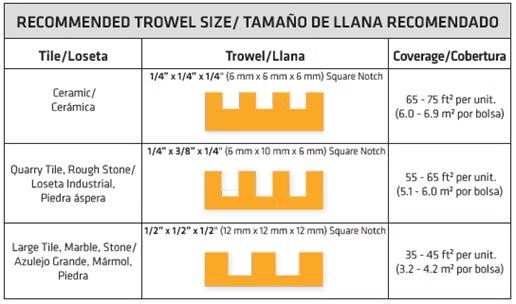
Read all installation instructions before installation. Choose a notched trowel with sufficient depth to achieve more than 80% mortar coverage and transfer to substrate and back of tile to both the tile and substrate for all interior applications, and more than 95% for exterior, commercial floor and wet applications, back-butter the tile to meet these requirements. With pressure, apply a coat of mortar by using the flat side of the trowel to key the mortar into the substrate. With the notched side of the trowel, apply additional mortar by combing it in a single direction parallel to the shortest dimension of the tile. Spread only as much mortar as can be tiled before the product skins over. Open time can vary with jobsite conditions. Set tiles firmly into the wet mortar and push the tiles back and forth in a direction perpendicular to trowel lines to collapse the mortar ridges and to help achieve maximum coverage.
MOVEMENT JOINTS:
All expansion, control, construction, cold, saw-cut, isolation, contraction, and seismic joints in the structure should continue through the tilework, including such joints at vertical surfaces, as specified per TCNA Method EJ171 or TTMAC Specification Guide 09 30 00, Detail 301MJ. Do not cover movement joints with mortar.
CURING TREATMENT
Product Curing time is affected by ambient and surface temperatures and humidity. Use the following as a guideline. Allow 24-48 hours before grouting and light traffic, and 7 days before heavy or vehicular traffic. As necessary, use plywood or other load distributing protection when moving heavy equipment across tiled assembly.
CLEANING
Clean tools and tile with water before the material dries.