

Sikafloor® DecoDur Quartz TG
Sikafloor® DecoDur Quartz TG is a troweled floor system built with a high solids epoxy and colored quartz aggregates. The system produces a robust, decorative, low maintenance, seamless flooring with excellent durability and chemical resistance. Sikafloor® DecoDur Quartz TG is typically installed @ 1/18'' - 1/4" (3.2 - 6.3 mm).
- Lower maintenance and life cycle cost vs. other flooring options
- Tough, durable and seamless floor
- Customizable to compliment any decor
- Very low VOC
- A wide range of textures and finishes available
- Optional Integral cove base and curbs available
- Crack-bridging and waterproofing membrane options
System Structure

Usage
- Break rooms and cafeterias
- Pharmaceutical plants
- Laboratories
- Hospitals & health care facilities
- Educational facilities
- Locker rooms areas
- Prisons/correctional facilities
- Stadiums
Advantages
- Lower maintenance and life cycle cost vs. other flooring options
- Tough, durable and seamless floor
- Customizable to compliment any decor
- Very low VOC
- A wide range of textures and finishes available
- Optional Integral cove base and curbs available
- Crack-bridging and waterproofing membrane options
System Details
System Structure
Sikafloor® DecoDur Quartz TG ~ 1/8'' - 1/4" (3.2 - 6.3 mm)
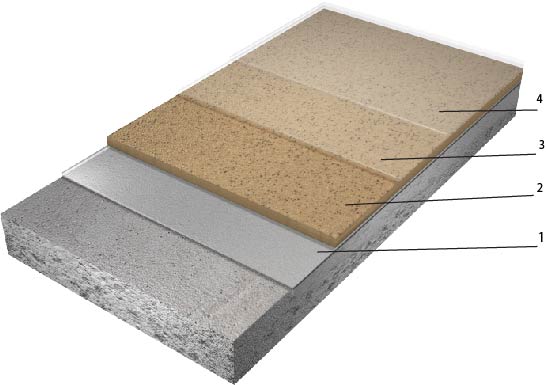
| Description | Products | Thickness mils |
| 1. Primer | Sikafloor®-161 | 8 - 10 |
| 2. Mortar | Sikafloor®-217 + Trowel Grade Quartz + Sikafloor® Decorative Quartz |
1/8" - 1/4" |
| 3. Grout Coat | Sikafloor®-217 Thixo Lite* | 10 - 12 |
| 4. Top Coat | Sikafloor®-217 Thixo Lite | 5 - 12 |
Options
| Description | Products | Thickness mils |
| Primers | Sikafloor®-1620
Sikafloor®-165 FS | 12 - 15
8 - 10 |
| 2nd Grout Coat | Sikafloor®-217 Thixo Lite* | 5 - 12 |
| Top Coats | Sikafloor®-511**
Sikafloor®-340***
Sikafloor®-315 N***
Sikafloor®-304 W NA**** | 12 - 16
4 - 6
4 - 6
5 - 8 |
* Sikafloor®-217 Thixo Lite, second grout coat may be required
** Sikafloor®-217 Thixo Lite may be replaced by Sikafloor®-511 for greater UV resistance and faster cure time
*** Sikafloor®-340 and Sikafloor®-315 N clear would be an optional top coat for increased chemical resistance
**** Sikafloor®-304 W NA would be an optional top coat on top of Sikafloor®-217 N for gloss reduction or matte finish
Nominal thickness
1/8'' - 1/4" (3.2 - 6.3 mm)
Minimum thickness
1/8'' (3.2 mm)
Water Absorption
| 0.3% (2 hours boiling) | ASTM C413 at 73°F (23°C) and 50% R.H |
Shore D Hardness
| 80 | ASTM D2240 at 73°F (23°C) and 50% R.H |
Abrasion Resistance
| 0.085 mg loss (CS-17/1000 rotations/1000g) | ASTM D4060 at 73°F (23°C) and 50% R.H |
Impact Strength
| >160 in.lb | Gardner Impact Tester |
Indentation
| 1.30% | (MIL-PRF-24613) |
Compressive Strength
| 10,700 psi (73.8 Mpa) | ASTM C579 at 73°F (23°C) and 50% R.H |
Tensile Strength
| 6,800 psi (46.9 MPa) | ASTM D638 at 73°F (23°C) and 50% R.H |
Flexural Strength
| 3,520 psi (24.3 MPa) | ASTM C580 at 73°F (23°C) and 50% R.H |
Reaction to Fire
| Flammability Self Extinguishing | ASTM D635 at 73°F (23°C) and 50% R.H |
Chemical Resistance
Contact Sika Technical Service for specific information.
Thermal Conductivity
| Coefficient of Thermal Expansion 2.3 x 10⁵ in/in/°F | ASTM C531 at 73°F (23°C) and 50% R.H |
Application
Ambient Air Temperature
Minimum/Maximum 50/85 ˚F (10/30 ˚C)
Substrate Temperature
Minimum/Maximum 50/85 ˚F (10/30 ˚C)
Coverage
| Description | Products | Approximates Sq.Ft./kit |
| 1. Primer | Sikafloor®-161 | 900@8 mils |
| 2. Mortar | Sikafloor®-217 + Trowel Grade Quartz + Sikafloor® Decorative Quartz | 420@3/16"
4.8 bags per 4.5 gallon kit
1.2 bags per 4.5 gallon kit |
| 3. Grout Coat | Sikafloor®-217 Thixo | 720@10 mils |
| 4. Top Coat | Sikafloor®-217 Thixo | 1,440@5 mils |
Options
| Description | Products | Approximates Sq.Ft./kit |
| Primers | Sikafloor®-1620
Sikafloor®-165 FS | 533@12 mils
1,000@8 mils |
| 2nd Grout Coat | Sikafloor®-217 Thixo Lite | 1,440@5 mils |
| Top Coats | Sikafloor®-511
Sikafloor®-340
Sikafloor®-315 N
Sikafloor®-304 W NA | 1,110@12 mils
6,000@4 mils
2,400@4 mils
595@5 mils |
SUBSTRATE PREPARATION
Concrete surfaces must be clean and sound. Remove all dust, dirt, existing paint films, efflorescence, exudates, laitance, form oils, hydraulic or fuel oils, brake fluid, grease, fungus, mildew, biological residues or any other contaminants which may prohibit a good bond.
Prepare the surface by any appropriate mechanical means, in order to achieve a profile equivalent to ICRI - CSP 3-6. The compressive strength of the concrete substrate should be at least 3,625 psi (25 MPa) at 28 days and a minimum of 218 psi (1.5 MPa) in tension at the time of application.
Repairs to cementitious substrates, filling of blowholes, leveling of irregularities, etc. should be carried out using an appropriate Sika profiling mortar. Contact Sika Technical Service for a recommendation.
Primer
Priming for concrete substrate is required. Prime with either Sikafloor®-160, Sikafloor®-161, Sikafloor®-1620 or Sikafloor®-165 FS.
Allow the primer to cure (varies with temperature and humidity) until tack free before applying subsequent membrane coats. Ensure that the primer is pore-free, pinhole-free and provides uniform and complete coverage over the entire substrate.
Please refer to the individual most current and respective Product Data Sheet for specific and detailed information.
Mortar
Premix each component separately. Measure out 32 ounces (1 quart) of Sikafloor®-217 Part A and 16 ounces (1 pint) of Sikafloor®-217 Part B. Pour A and B into a clean 5 gallon metal bucket.Mix with a very low speed jiffy mixer, mix for 2 to 3 minutes and until uniform. Be careful not to introduce any air bubbles while mixing. Make sure the contents are completely mixed to avoid any weak or partially cured spots in mortar.
During the mixing operations, scrape down the sides and bottom of the container with a flat or straight edge trowel to ensure complete mixing. Add two gallons of trowel grade quartz aggregate and one gallon Sikafloor® Decorative Quartz mix for an additional minute and until uniform. Mix only that quantity that can be used within its pot life and until uniform.
Place mixed mortar using a screed box, gauge rake, or steel trowel. Place as evenly as possible. Using a power trowel (with plastic blades) or a steel trowel by hand compact the mortar. Do not over trowel and do not finish the last 3 - 4 inches of the placed mortar
path, as this will make the transition of the next pass of mortar more difficult to finish. Use floor lights to examine finished work closely to assure complete closing and to identify any trowel marks or imperfections. No holes or tear marks should be visible. After cure scrape with the edge of a steel trowel any high rough spots and sweep and vacuum the surface.
Grout Coat
Sikafloor®-217 Thixo Lite: Mixing Ratio - 2 : 1 by volume. Premix each component separately. Empty Component B (Hardener) in the correct mix ratio into Component A (Resin). Mix the combined components for at least 3 minutes and until uniform using a low speed drill (300–450 rpm) and Exomixer or Jiffy type paddle suited to the volume of the mixing container to minimize entrapped air. Be careful not to introduce any air bubbles while mixing.
Make sure the contents are completely mixed to avoid any weak or partially cured spots in the coating. During the mixing operation, scrape down the sides and bottom of the container with a flat or straight edge trowel at least once to ensure complete mixing.
Apply with a flat rubber squeegee or flat metal trowel tightly over a smooth surface. Back rolling may cause bubbling and leave roller marks. Product has a limited Pot Life, see Typical Data. Do not apply by dipping roller into mixing container.
Top Coat
Sikafloor®-217 Thixo Lite is applied with a flat or notched rubber squeegee over a smooth surface. Back rolling is typically done with an 18 in. (455 mm) wide short nap, 3/16 or 1/4 in. (4 to 6 mm), solvent-resistant roller cover. Back roll the Sikafloor®-217 Thixo Lite only to level the squeegee applied material. Over-rolling and late back rolling may cause bubbling and leave roller marks.
Note: The orange peel texture finish texture peak through height will vary depending on the mill thickness and type of roller used. Do not apply the material above the recommended thickness, cloudiness/whitening may occur.