

Sikalastic® Vehicular Traffic 1500 Low VOC
Sikalastic® Vehicular Traffic 1500 Low VOC is a waterproofing system consisting of:
- Sikalastic® M 205, a low VOC, one-component, moisture-curing polyurethane
- Sikalastic® TC 235, a low VOC, one-component aliphatic moisture-curing polyurethane
- Primer coat not typically required which helps to reduce labor and material costs
- Waterproof to protect concrete from freeze/thaw damage; protects occupied areas below from water damage
- Excellent chloride resistance provides protection against chloride intrusion; extends the life of reinforcing steel
- Seamless elastomeric membrane offers excellent durability and superior abrasion resistance, has no seams that may result in leaks
- Provides skid resistance to increase safety and offers excellent durability and superior abrasion resistance
- Repairable and recoatable to extend the useful life of the system
System Structure
Usage
- Stadiums
- Parking Garages
- Commercial Construction
- Building and Restoration
- Plywood Decks
Advantages
- Primer coat not typically required which helps to reduce labor and material costs
- Waterproof to protect concrete from freeze/thaw damage; protects occupied areas below from water damage
- Excellent chloride resistance provides protection against chloride intrusion; extends the life of reinforcing steel
- Seamless elastomeric membrane offers excellent durability and superior abrasion resistance, has no seams that may result in leaks
- Provides skid resistance to increase safety and offers excellent durability and superior abrasion resistance
- Repairable and recoatable to extend the useful life of the system
Color
For color options, please refer to the corresponding Product Data Sheets
System Details
APPROVALS / STANDARDS
- UL 790 Class A Fire Rating
- ASTM C 957
- ASTM E 108
- ASTM E 84
- CSA S413
System Structure
- Sikalastic® M 205
- Sikalastic® TC 235
Composition
Sikalastic® Vehicular Traffic 1500 Low VOC is a moisture-curing polyurethane system.
Abrasion Resistance
| CS-17 Wheel, 1,000 g load, 1,000 cycles | 48 | ASTM D 4060 |
Elongation
| Elongation recovery % | 96 | ASTM C 957 |
| Tensile Retention % | 88 | |
| Elongation Retention % | 96 |
Application
Test Results
Allow curing time of 72 hours before vehicular use and 48 hours before pedestrian use. Extend the curing time in cool-weather conditions.
SUBSTRATE PREPARATION
Concrete
1. Concrete must be fully cured (28 days), structurally sound, clean and dry (ASTM D 4263). All concrete surfaces (new and old) must be shot blasted to remove previous coatings, laitance and all miscellaneous surface contamination and to provide profile for proper adhesion. Abrasive shot blasting must occur after concrete repair has taken place. Acid-etching is not permitted. Proper profile should be a minimum of ICRI CSP- 3 (as described in ICRI document 03732.) For balconies and other pedestrian areas with limited space or access for shot-blasting, alternative mechanical methods can be used to achieve the recommended surface profile.
2. Repair voids and delaminated areas with Sika branded cementitious and epoxy patching materials. For application when fastturn repairs are required, Sikalastic®-350 can be used to repair patches up to 1.5" in depth when used in aggregate slurry mix. Please refer to the Sikalastic®-350 product Data sheet for proper application techniques.
3. All units must be applied within the specified pot life.
Surface Pre-Striping and Detailing
1. For non-moving joints and cracks less than 1⁄16" (1.6 mm) wide, apply 25 wet mils (0.6 mm) prestriping of Sikalastic® M 205. Sikalastic® M 205 must be applied to fill and overlap the joint or crack 3" (76 mm) on each side. Feather the edges.
2. Dynamic cracks and joints over 1⁄16" (1.6 mm) wide must be routed to a minimum of ¼" by ¼" (6 by 6 mm) and cleaned. Install bond breaker tape to prevent adhesion to bottom of joint. When required, prime all joint faces only with the appropiate Sika® Primer. Fill joints deeper than ¼" (6 mm) with appropriate backer rod and Sikaflex® SL 1™/ SL 2™ (slope grade or selfleveling) or Sikaflex® NP 1™/ NP 2™. For cracks, sealant should be flush with the adjacent surface. For expansion joints, sealant should be slightly concave. Once the sealant is cured the lines should be prestriped with base coat Sikalastic® M 205, overlap the joint 3" (76 mm) on each side.
3. Sealed joints 1" (25 mm) wide or less can be coated over with the Sikalastic® Traffic system. Expansion joints exceeding 1" (25 mm) wide, including the primary wide expansion-joint system, are not to be coated so they can perform independently of the deck coating system.
4. Where the coating system will be terminated and no wall, joint or other appropriate break exists, cut an ¼" x ¼" (6 x 6 mm) keyway into the concrete. Fill and coat keyway during application of Sikalastic® M 205.
5. Form a sealant cant into the corner at the junction of all horizontal and vertical surfaces (wall sections, curbs, columns) by priming with the appropiate Sika® Primer and applying a 1" (25 mm) wide bead of Sikaflex® NP 1™/ NP 2™. Tool to form a 45° cant. Apply masking tape to the vertical surfaces 4–5" (102–127 mm) above the sealant cant to provide a clean termination of the vertical detail coat. After the sealant has cured, apply 25 wet mils (0.64 mm) of Sikalastic® M 205 over the cured cant up to the masking tape and 4" (102 mm) onto deck surface.
6. In locations of high movement such as wall and slab intersections, a reinforcing fabric is required. After the sealant cant bead is applied
and cured, apply 25 wet mils of Sikalastic® M 205 over the sealant and embed Sikalastic Fleece- 996 reinforcing fabric into the wet detail coat.
Uncoated Metal Surfaces
1. Remove dust, debris, and any other contaminants from vent, drain-pipe and post penetrations, reglets and other metal surfaces. Clean surfaces to near white per SSPC-NACE2 and prime immediately with the appropiate Sika® Primer. Provide appropriate cant with Sikaflex® NP 1™/ NP 2™. Apply a detail coat of 25 wet mils of Sikalastic® M 205 over the primed metal and sealant.
Plywood
1. All plywood must be smooth-faced, APA-stamped and exterior grade tongue and groove. Construction must conform to code, but plywood must not be less than 23⁄32" (20 mm) thick. Plywood spacing and deck construction must follow APA guidelines.
2. Surfaces must be free of contaminants. Priming is not necessary on clean, dry plywood.
3. All seams must be caulked with Sikaflex® NP 1™/ NP 2™ sealants. Pre-stripe 4–6" (102–152 mm) wide with 25 wet mils (0.64 mm) of M 205. Reinforce all seams between plywood sheets and between flashing and the plywood deck by embedding Sikalastic® Fleece-996 Reinforcing Fabric into the pre-striping.
MIXING
Please refer to the specific PDS for Mixing instructions
APPLICATION
PRIMER
NOTE: When primer is required on a job, contact your local Sika representative.
SIKALASTIC® M 205
- All preparatory work must be completed before application begins. Be certain the substrate is clean, dry, stable and properly profiled. Sealants and pre-striping should be properly cured. Apply the base, mid and finish coats with a properly sized squeegee to arrive at the required mil thicknesses.
- Apply Sikalastic®M 205 at 25 wet mils thick (0.64 mm) using a proper notched squeegee to entire deck surface, and back roll, overcoating the properly prepared cracks, joints and flashings. Do not coat expansion joints over 1" (25 mm) wide.
- Allow curing time of overnight (16-hour minimum). Extend the curing time in cool or dry weather conditions. The surface of Sikalastic® M 205 should have a slight tack. If the coating has been exposed for a prolonged period, consult Technical Service for recommendations.
APPLICATION METHODS OF SYSTEMS
Sikalastic® Vehicular Traffic 1500 Low VOC can be installed in several configurations, depending upon the degree of traffic to which the system is exposed. In areas of extreme traffic (turning lanes, pay booths, entrances and exits), apply the Extra Heavy-Duty Traffic System. The following summary briefly describes each configuration. All coverage rates are approximate.
LIGHT- TO MEDIUM- DUTY TRAFFIC SYSTEM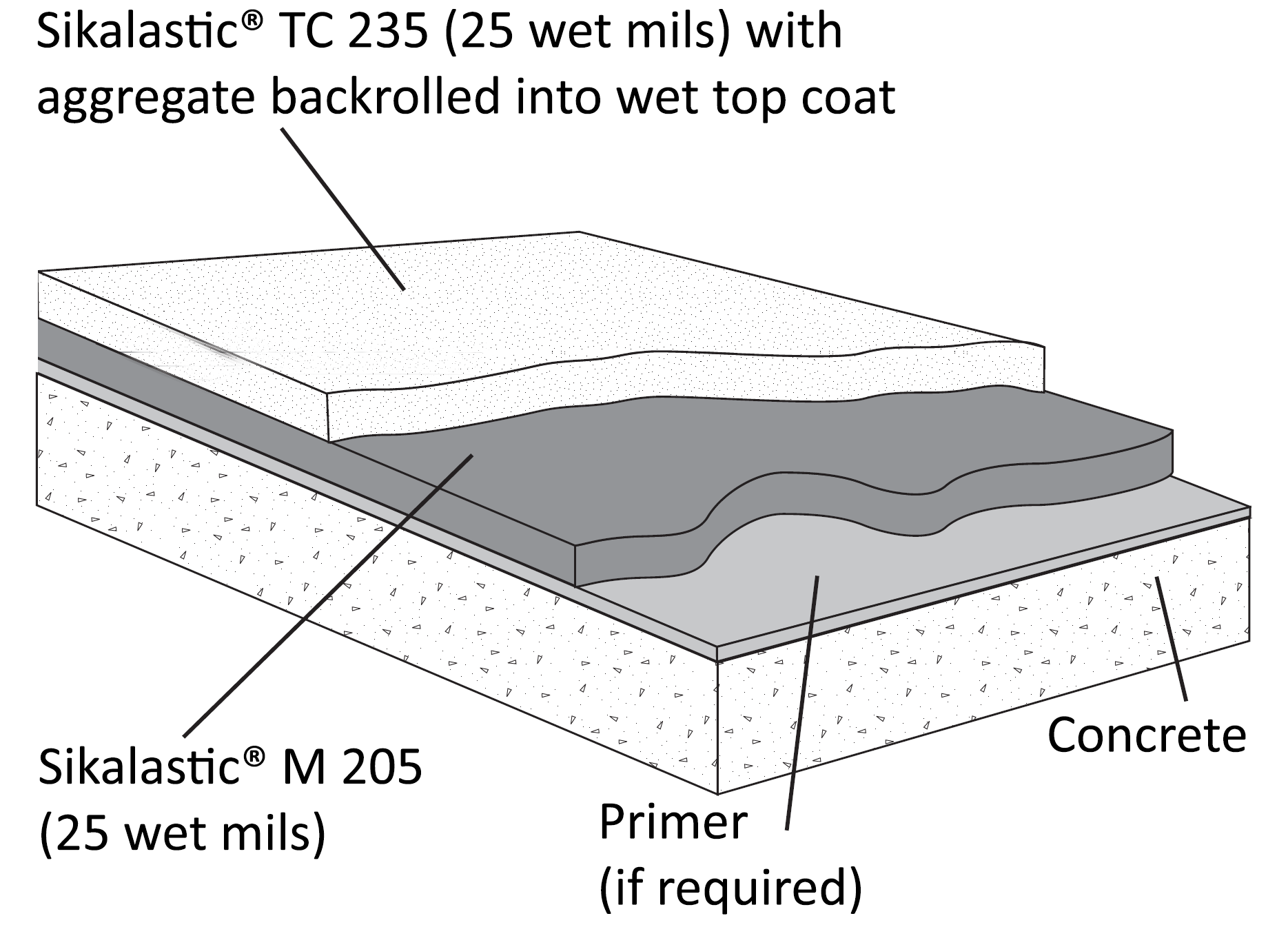
1. Prime substrate if required, consult your Sika Representative.
2. Apply 25 (0.64 mm) wet mils of Sikalastic® M 205 using a proper notched squeegee at 55–60 ft2/gal (1.35–1.47 m2/L). Immediately backroll to level base coat. Allow to cure overnight.
3. Apply 25 wet mils (0.64 mm) Sikalastic® TC 235 using a proper notched squeegee at 55–60 ft2/gal (1.35–1.47 m2/L). Immediately backroll to level Sikalastic® TC 235 material.
4. While the coating is still wet, broadcast aggregate 16/30 or equivalent rounded silica sand at 15–25 lbs/100 ft2/gal (0.75–1.25 kg/m2), then backroll into the coating to fully encapsulate.
5. When installing the Sikalastic® TC 235 Tint Base, a second coat may be required for proper hiding. A mock-up should be performed to address any aesthetic expectations.
HEAVY-DUTY TRAFFIC SYSTEM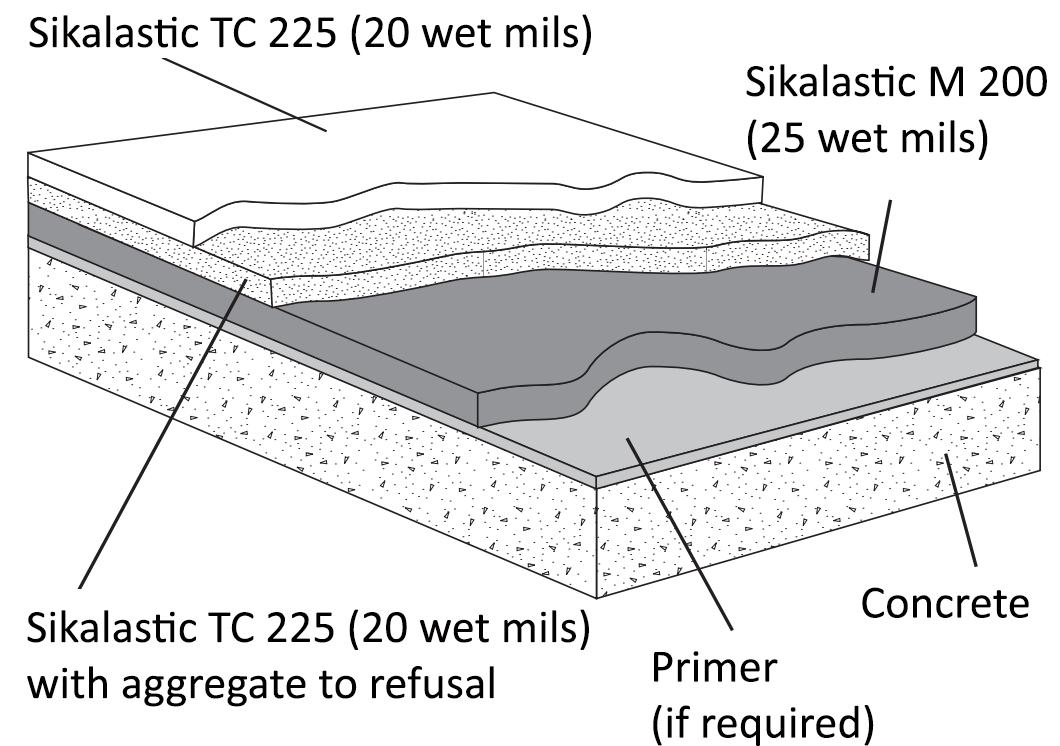
1. Prime substrate if required; consult your Sika Representative.
2. Apply 25 (0.64 mm) wet mils of Sikalastic® M 205 or using a proper notched squeegee at 55–60 ft2/gal (1.35–1.47 m2/L).Immediately backroll to level base coat. Allow to cure overnight
3. Apply 20 wet mils (0.51 mm) Sikalastic® TC 235 using a notched squeegee at 75–80 ft2/gal (1.83–1.97 m2/L). Immediately backroll to level Sikalastic® TC 235. The next step, #4, can utilize either method described in 4A or 4B. Sikalastic® TC 235 Tint Base is NOT intended for vehicular systems.
4. AGGREGATE
4A. AGGREGATE TO REFUSAL METHOD - Immediately broadcast aggregate 16/30 or equivalent rounded silica sand into the wet coating at the rate of 20–35 lbs/100 ft2 (1.0–1.75 kg/m2). Immediately after the aggregate broadcast and while the coating is still wet, blow any excess aggregate via a portable blower forward into the wet coating. Do not over-apply aggregate; it is acceptable to have localized wet spots in the aggregate surface after completion of this method. This process requires coordination between all of the members in the work crew. The blower operator, wearing clean spiked shoes, should blow the excess aggregate forward toward the freshly applied and back-rolled topcoat. In this method, the coating should not accept additional sand, minimal excess aggregate is on the surface, less aggregate is used and the textured appearance should be fairly uniform.
4B. BROADCAST AND BACKROLL METHOD - Immediately broadcast aggregate 16/30 or equivalent rounded silica sand into the wet coating and backroll to encapsulate the aggregate. Evenly broadcast aggregate at the rate of 15–20 lbs/100 ft2 (0.75–1.0 kg/m2). Allow to cure overnight.
5. Ensure there is no moisture on the surface of the aggregate/membrane before application of topcoat. Remove all loose aggregate, then apply 20 wet mils using a flat squeegee at 75–80 ft2/gal (1.84–1.96 m2/L). Immediately backroll to level Sikalastic® TC 235.
6. For additional slip resistance, immediately broadcast aggregate 16/30 or equivalent rounded silica sand at a rate of 3–5 lbs/100 ft2 (0.15–0.25 kg/m2) and backroll to encapsulate.
EXTRA-HEAVY DUTY SYSTEM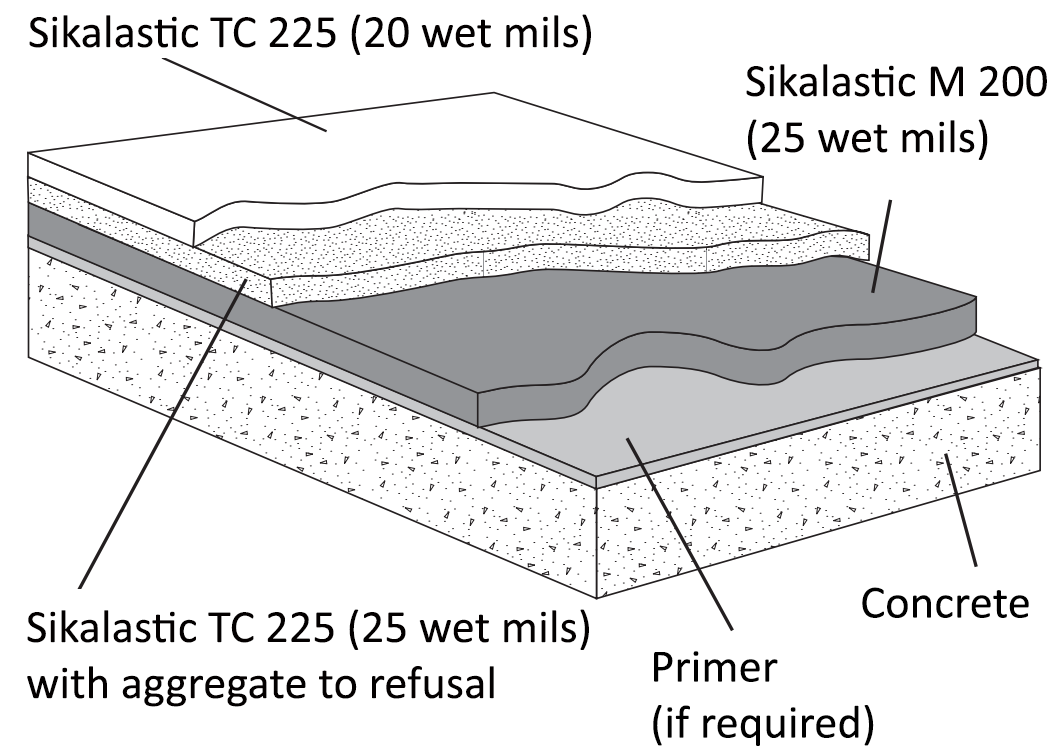
1. Prime substrate if required; consult your Sika Representative.
2. Apply 25 (0.64 mm) wet mils of Sikalastic® M 205 using a proper notched squeegee at 55–60 ft2/gal (1.35–1.47 m2/L). Immediately backroll to level base coat. Allow to cure overnight.
3. Apply 25 wet mils (0.64 mm) Sikalastic® TC 235 or using a properly notched squeegee at the rate of 55–60 ft2/gal (1.35–1.47 m2/L). Immediately backroll to evenly level topcoat. The next step, #4, can utilize either method described in 4A or 4B. Sikalastic® TC 235 Tint Base is NOT intended for vehicular systems.
4. AGGREGATE
4A. AGGREGATE TO REFUSAL METHOD Immediately broadcast aggregate 16/30 or equivalent rounded silica sand into the wet coating at the rate of 20–35 lbs/100 ft2 (1.0–1.75 kg/m2). Immediately after the aggregate broadcast and while the coating is still wet, blow any excess aggregate via a portable blower forward into the wet coating. Do not over-apply aggregate; it is acceptable to have localized wet spots in the aggregate surface after completion of this method. This process requires coordination between all of the members in the work crew. The blower operator, wearing clean spiked shoes, should blow the excess aggregate forward toward the freshly applied and back-rolled topcoat. In this method, the coating should not accept additional sand, minimal excess aggregate is on the surface, less aggregate is used and the textured appearance should be fairly uniform
4B. BROADCAST AND BACKROLL METHOD - Immediately broadcast aggregate 16/30 or equivalent rounded silica sand into the wet coating and backroll to encapsulate the aggregate. Evenly broadcast aggregate at the rate of 15–25 lbs/100 ft2 (0.75–1.25 kg/m2). Allow to cure overnight.
5. Ensure there is no moisture on the surface of the aggregate/membrane before application of topcoat. Remove all loose aggregate, then apply 20 wet mils using a flat squeegee at 75–80 ft2/gal (1.84–1.96 m2/L). Immediately backroll to level Sikalastic® TC 235.
6.For additional slip resistance, immediately broadcast aggregate 16/30 or equivalent rounded silica sand at a rate of 3–7 lbs/ 100 ft2 (0.15–0.25 kg/m2) and backroll to encapsulate.
IMPORTANT NOTE: All coverage rates are approximate and may vary due to the application technique used. Coverage rates are affected by substrate texture, choice and distribution of aggregate, intermediate coat aggregate load and environmental conditions. Application methods and conditions are not under the control of Sika. Ensure that an adequate amount of aggregate is utilized to achieve desired slip resistance.
MOCKUP
1. Provide mockup of at least 100 ft2 (9.3 m2) to include surface profile, sealant joint, crack, flashing and juncture details and allow for evaluation of slip resistance and appearance.
2. Install mockup with specified coating types and with other components noted.
3. Locate where directed by architect.
4. Mockup may remain as part of work if acceptable to architect. For recoat applications, contact Sika Technical Services.
CLEANING OF TOOLS
Clean all tools and equipment immediately after use with SikaSwell® 990 or xylene. Cured material must be removed mechanically.